440Hz, 82.41Hz, and Guitar Tuning: From Pitch Standards to Precision Frequency Detection
440Hz and 82.41Hz are two of the most commonly misunderstood frequencies in guitar tuning. Understanding pitch standards, guitar string frequencies, and sound analysis principles is essential to achieving truly accurate tuning.
1. 440Hz: The Standard Pitch Reference in Modern Music
Images are created by iStingor for technical illustration.
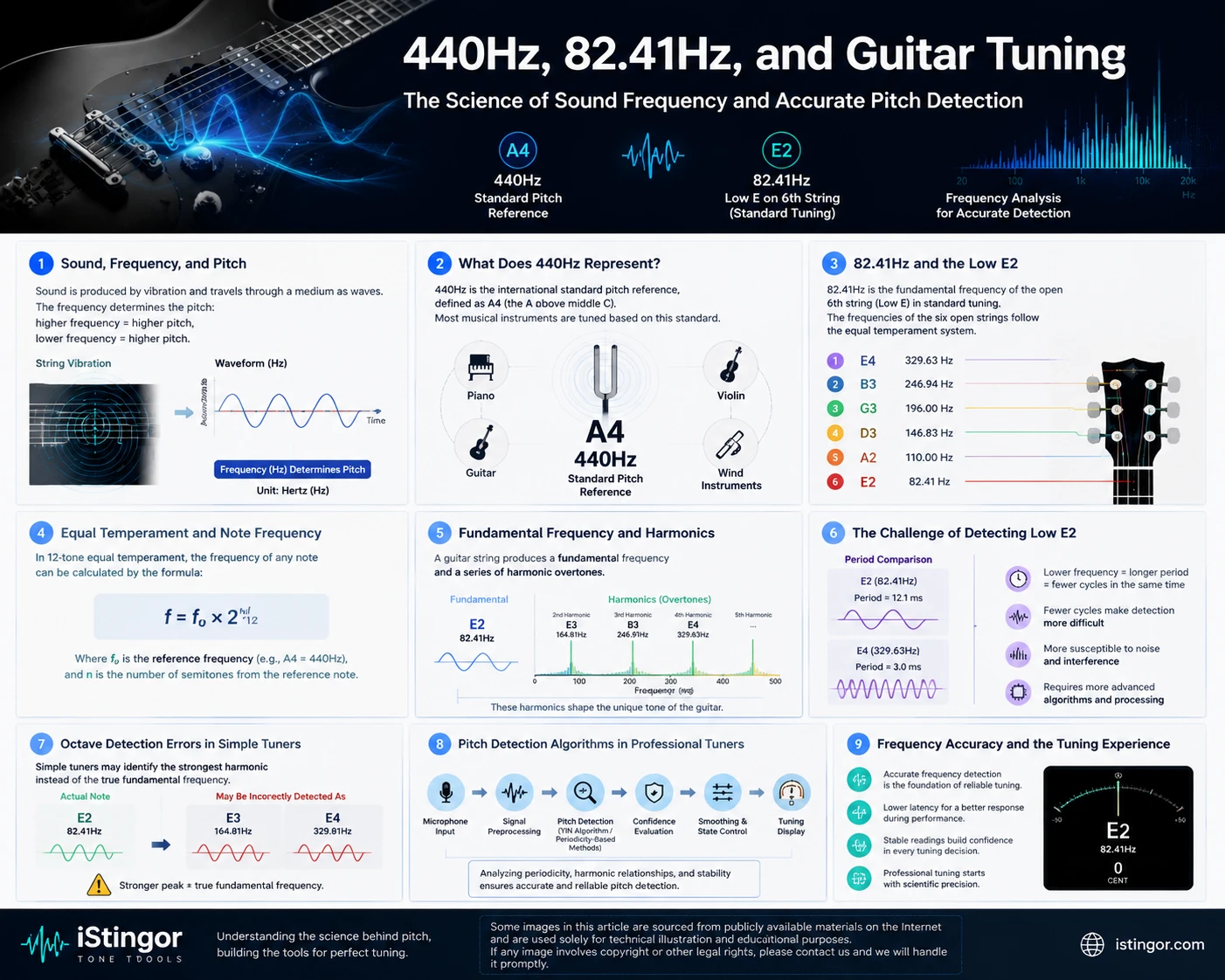
In the modern musical system, 440Hz is one of the most important pitch references. From instrument manufacturing and live performance to recording production and digital audio software, many musical devices use this standard as the foundation for pitch calibration.
When we see “A4 = 440Hz”, it means that the A4 note in the standard pitch system is defined as vibrating at 440 cycles per second. This definition creates a universal pitch reference, allowing different instruments to maintain accurate relationships with each other. Pianos, guitars, violins, and electronic instruments can all be tuned and performed based on this standard.
It is important to understand that 440Hz is not the target frequency of every instrument, nor is it the fixed tuning frequency of a guitar string. Instead, it works as a reference scale that provides a consistent pitch system for music.
Modern music commonly uses the Equal Temperament system. In this system, one octave is divided into 12 equal semitones, and each semitone follows the same frequency ratio. Using A4=440Hz as the reference, the frequency of any note can be calculated using the following formula:
\[
f_n = f_0 \times 2^{\frac{n}{12}}
\]
Where:
\(f_n\) represents the frequency of the target note;
\(f_0\) represents the reference frequency;
\(n\) represents the number of semitones between the target note and the reference note.
For example, if A4=440Hz is used as the reference, moving down 12 semitones means lowering one octave:
\[
f = 440 \times 2^{-\frac{12}{12}}
\]
The result is:
\[
f = 220Hz
\]
which is the frequency of A3.
Through this mathematical relationship, every note in the musical system can be accurately calculated. The importance of 440Hz is not that every instrument must produce this frequency, but that it provides a universal language shared by musicians, instruments, and audio systems.
2. 440Hz Is Not the Target Frequency of a Guitar String
Many guitar players have a common question when they first use a tuner: since the number 440Hz often appears in tuning settings, should guitar strings also be tuned to 440Hz?
The answer is no. 440Hz is only the reference standard of the musical system, not the target frequency of a specific guitar string. It represents the standard frequency of A4, while each guitar string has its own target pitch calculated from the Equal Temperament system.
The tuning frequencies of a standard six-string guitar are:
String
Note
Frequency
1st string
E4
329.63Hz
2nd string
B3
246.94Hz
3rd string
G3
196.00Hz
4th string
D3
146.83Hz
5th string
A2
110.00Hz
6th string
E2
82.41Hz
Among these frequencies, the open low E string (E2, 82.41Hz) is one of the most important low-frequency references in guitar tuning.
Using the Equal Temperament formula:
\[
f_n = f_0 \times 2^{\frac{n}{12}}
\]
With A4=440Hz as the reference, E2 is located 29 semitones below A4:
\[
f_{E2}=440 \times 2^{-\frac{29}{12}}
\]
The result is:
\[
f_{E2}\approx82.41Hz
\]
This is the mathematical origin of the standard guitar low E string frequency.
Therefore, the 440Hz setting on a tuner does not mean that a guitar string should directly produce 440Hz. Instead, it provides the reference point used to calculate target frequencies, allowing the tuner to compare the actual string vibration with the correct pitch.
3. Why the Low E String Is 82.41Hz
The pitch of a guitar is not created randomly. It is based on precise mathematical relationships. The octave relationship in music determines how frequencies change: when a note rises by one octave, its frequency doubles; when it drops by one octave, its frequency is divided by two.
This relationship can be expressed as:
\[
f_{octave}=f \times 2^n
\]
Where:
\(f\) represents the base frequency;
\(n\) represents the number of octave changes.
For example:
A4 = 440Hz
Lowering one octave:
\[
440 \times 2^{-1}=220Hz
\]
This gives A3.
Lowering another octave:
\[
220 \times 2^{-1}=110Hz
\]
This gives A2.
This octave relationship forms an essential foundation of the modern musical pitch system.
The lowest note of a standard six-string guitar is E2, which is approximately 82.41Hz. Because low-frequency sounds have longer vibration cycles, a tuner needs more time to analyze the signal before producing a stable result.
Low-frequency signals are also more affected by environmental noise, picking dynamics, and string condition. Therefore, E2 is not only the lowest standard guitar note but also an important reference for evaluating tuning algorithm stability.
4. How Equal Temperament Defines Guitar Pitch Relationships
The pitch system used by modern guitars is based on the Equal Temperament system. The core idea of Equal Temperament is to divide one octave into 12 equal semitones while maintaining the same frequency ratio between each note.
This design allows instruments to maintain consistent pitch relationships across different keys and musical situations, making instruments such as guitars, pianos, and other musical devices compatible within the same tuning system.
In Equal Temperament, the frequency ratio between two adjacent semitones is:
\[
r = 2^{\frac{1}{12}}
\]
This means that every semitone increase multiplies the frequency by approximately 1.05946, while every semitone decrease divides the frequency by the same ratio.
Once the frequency of a reference note is known, all other notes can be calculated:
\[
f_n = f_0 \times 2^{\frac{n}{12}}
\]
Where:
\(f_n\) represents the frequency of the target note;
\(f_0\) represents the reference frequency;
\(n\) represents the number of semitones between the target note and the reference note.
Using A4=440Hz as an example:
A4 to A3 is 12 semitones lower:
\[
f_{A3}=440 \times 2^{-\frac{12}{12}}
\]
The result is:
\[
f_{A3}=220Hz
\]
Moving another 12 semitones lower:
\[
f_{A2}=440 \times 2^{-\frac{24}{12}}
\]
The result is:
\[
f_{A2}=110Hz
\]
For guitar tuning, this mathematical relationship defines the target frequency of every string. From the low E2 string to the high E4 string, all target frequencies are calculated from the same pitch reference system.
A modern tuner therefore does not simply memorize a few fixed frequencies. Instead, it uses a complete frequency mapping system built on the principles of musical theory.
5. How Does a Tuner Detect Guitar Pitch?
When a guitarist plucks a string, a tuner does not receive a pre-labeled note name. Instead, the microphone first captures the sound vibration from the string and converts it into digital audio data. The algorithm must then analyze this data to determine the true vibration frequency of the string.
A complete pitch detection process usually includes audio capture, signal preprocessing, periodic analysis, fundamental frequency detection, note conversion, and pitch deviation calculation.
The most important task is identifying the fundamental frequency within a complex waveform. The fundamental frequency determines the pitch we perceive, while other frequency components mainly contribute to the tone color of the instrument.
A guitar does not produce a simple single-frequency signal. When a string vibrates, it generates both a fundamental frequency and multiple harmonics, which combine to create the final sound. Therefore, a tuner cannot rely only on the strongest frequency peak but must analyze the complete structure of the audio signal.
Professional tuning algorithms usually combine periodic detection, frequency analysis, signal stability evaluation, and temporal smoothing to achieve a balance between fast response and accurate pitch recognition.
6. Why Guitar Pitch Detection Is More Challenging Than It Seems
If a sound contained only a pure sine wave, detecting its frequency would be relatively simple. However, the sound produced by a real guitar is far more complex. A vibrating string produces not only the fundamental frequency that determines pitch, but also many harmonics. These different frequency components work together to create the tonal character of the instrument.
From a mathematical perspective, a real instrument sound can be represented as the combination of multiple harmonic components:
\[
x(t)=\sum_{n=1}^{N} A_n\sin(2\pi n f_0 t+\phi_n)
\]
Where:
\(x(t)\) represents the sound signal changing over time;
\(f_0\) represents the fundamental frequency;
\(n f_0\) represents the frequency of the nth harmonic component;
\(A_n\) represents the amplitude of the nth harmonic component;
\(\phi_n\) represents the phase offset of the nth harmonic component.
Taking the standard high E4 string as an example, its fundamental frequency is approximately 329.63Hz:
\[
f_0=329.63Hz
\]
However, the actual sound produced by the string also contains higher harmonic components.
The second harmonic:
\[
2f_0=2\times329.63=659.26Hz
\]
The third harmonic:
\[
3f_0=3\times329.63=988.89Hz
\]
These harmonics do not change the main pitch that we perceive, but they strongly influence the brightness, fullness, and unique tonal character of the guitar. If a tuning algorithm only searches for the strongest frequency component, it may incorrectly identify a strong harmonic as the actual pitch.
For example, if the fundamental frequency at 329.63Hz is relatively weak while the second harmonic at 659.26Hz is stronger, a simple algorithm may incorrectly identify the actual E4 note as a higher octave. This phenomenon is known as octave error and is one of the major challenges faced by basic pitch detection methods.
A professional tuner therefore cannot rely only on the strongest peak in the frequency spectrum. It must analyze periodic characteristics, harmonic relationships, and temporal consistency. The algorithm must determine not only “which frequencies exist in the signal,” but also “which frequency represents the true fundamental vibration of the string.”
In addition to harmonic complexity, guitar sounds also change significantly over time. The moment a string is plucked contains strong transient information, and the sound gradually becomes stable afterward. If an algorithm focuses too much on response speed, it may be affected by transient changes; if excessive smoothing is applied, the tuning response may become slow.
A high-quality pitch detection algorithm must therefore achieve a balance between response speed, stability, and accuracy.
7. Low E2: A Critical Test for Tuning Algorithm Performance
For a standard six-string guitar, the open low E string E2 (approximately 82.41Hz) is one of the most important references for evaluating tuning algorithm performance.
Compared with high-frequency signals, low-frequency sounds have longer vibration cycles. For an E2 note at 82.41Hz, the string vibrates about 82 times per second, meaning the algorithm needs a sufficient analysis window to accurately determine its periodic behavior. If the analysis period is too short, the result can be affected by transient changes and noise.
The challenge of detecting low E2 does not come only from its low frequency. Real playing conditions introduce many variables, including string thickness, material, age, picking dynamics, pickup type, and surrounding environment.
Low-frequency guitar notes also contain strong harmonic structures. If an algorithm cannot correctly distinguish between the fundamental frequency and harmonics, octave errors may occur. For example, an actual E2 note may be incorrectly detected as E3 or another pitch because of stronger harmonic components.
For this reason, professional tuners usually do not determine the note from a single detection result. Instead, they combine confidence evaluation, continuous analysis, and stability checking to ensure that the final pitch information is reliable.
For guitarists, accurate low E2 detection is one of the key indicators of a truly professional tuning experience.
8. Cents: A Precise Unit for Measuring Pitch Deviation
During the tuning process, knowing only the current note name is often not enough. For guitarists, it is more important to understand how far the current string is from the target pitch. To describe these small pitch differences accurately, the musical world uses a unit called cents.
In the Equal Temperament system, one octave is divided into 12 semitones, and each semitone is further divided into 100 cents. Therefore, one complete octave contains 1200 cents.
This system allows tuners to represent very small pitch variations. For example, when a tuner displays -5 cents, it means the current string frequency is slightly lower than the target pitch. When it displays +5 cents, the frequency is slightly higher than the target pitch.
The cents value is calculated from the ratio between the detected frequency and the target frequency:
\[
cents = 1200 \times \log_2(\frac{f}{f_0})
\]
Where:
\(f\) represents the detected actual frequency;
\(f_0\) represents the reference frequency of the target note.
This formula describes the relationship between frequency ratio and perceived pitch difference. When the detected frequency equals the target frequency:
\[
\frac{f}{f_0}=1
\]
Therefore:
\[
cents = 1200 \times \log_2(1)=0
\]
This means the pitch is perfectly matched.
If the current frequency is higher than the target frequency:
\[
f>f_0
\]
the result is positive, indicating that the pitch is sharp.
If:
\[
f<f_0
\]
the result is negative, indicating that the pitch is flat.
For guitar performance, a difference of only a few cents may not always be immediately noticeable, but stable and accurate pitch becomes important in recording, ensemble playing, and precise tone control. This is why professional tuners usually display both the note name and cents deviation, allowing musicians to make more accurate adjustments.
9. The Digital Signal Processing Behind Accurate Tuning
Modern tuners can quickly recognize guitar pitch not because they simply measure the strongest frequency peak in a sound, but because they use digital signal processing techniques to analyze the audio in depth.
The fundamental frequency detection process is the core task of a tuning algorithm. For instruments like guitar that contain rich harmonic structures, the algorithm must identify periodic patterns and determine the true fundamental vibration hidden within a complex waveform.
The YIN algorithm is a commonly used periodic analysis method for pitch detection. It compares the differences between a signal and its delayed version at different time intervals to find the most likely periodic component.
Its core concept can be expressed as:
\[
d(\tau)=\sum_{j=1}^{N}(x_j-x_{j+\tau})^2
\]
Where:
\(x_j\) represents the j-th sample point;
\(\tau\) represents the time delay;
\(d(\tau)\) represents the difference between the signal and its delayed version.
When the delay value approaches the true period of the sound, the difference between the two waveforms becomes smaller. The algorithm can then estimate the fundamental frequency by finding the most suitable period.
To reduce the influence of signal strength variations, YIN further applies normalization:
Compared with simple spectral peak detection, this approach is more suitable for instruments like guitar, which produce complex waveforms with strong harmonics.
However, no single algorithm can solve every challenge alone. Professional tuners usually combine confidence evaluation, temporal consistency analysis, octave error correction, and smoothing techniques to achieve stable and reliable results.
From audio capture to the final note display, a high-quality tuner combines audio engineering, mathematical modeling, and musical theory into a single practical tool.
10. From Frequency Detection to Playing Experience: The Meaning of a Professional Tuner
At first glance, a tuner may appear to be a simple tool that displays note names and frequency values. However, for serious guitarists, a great tuner serves a much greater purpose. It connects the instrument, the player, and musical expression by helping musicians establish an accurate and stable pitch foundation before they begin playing.
Guitar tuning is affected by many factors, including string material, temperature changes, playing dynamics, bending techniques, and the condition of the strings after extended use. Tuning is therefore not simply a matter of matching one frequency value. It is the process of finding the most reliable pitch judgment in a constantly changing real-world environment.
A professional tuner must solve several challenges at the same time. It needs to respond quickly so players do not have to wait, remain stable enough to avoid incorrect readings caused by temporary changes, and maintain enough accuracy to reveal small pitch deviations.
Behind these requirements is a combination of musical theory, mathematical models, and digital signal processing technology. From the 440Hz pitch standard and the 82.41Hz low E2 string to pitch detection algorithms based on periodic analysis and signal processing, modern tuners represent a powerful combination of music and technology.
For iStingor, creating a tuning tool is not simply about adding another software feature. The goal is to provide reliable and professional tools that help more guitarists improve their playing experience. Great tools do not replace musical creativity; they remove unnecessary obstacles and allow musicians to express themselves more freely.
Accurate pitch is the foundation of a great playing experience, and reliable technology serves as an important bridge between musical inspiration and real sound.